
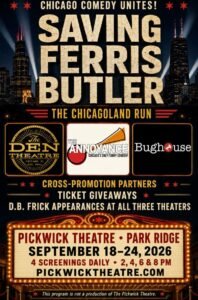
DB Frick is the executive producer of the documentary “Saving Ferris Butler,” which will be at the Pickwick Theater in Chicago as part of an Oscar-qualifying run in September. Mr. Frick is also a contributor to Stagebiz.com
What is the premise of your film, Saving Ferris Butler?
Saving Ferris Butler is about comedian, writer and filmmaker Ferris Butler, a largely overlooked figure in American comedy history. Ferris created the pioneering New York cable-access comedy series Waste Meat News in the 1970s and was later hired as a writer and performer during the infamous sixth season of Saturday Night Live.
The film explores his work, his influence and his claim that he inspired the name and certain elements of Ferris Bueller’s Day Off. But it is also about what happens when a talented artist contributes to the culture and then gets left out of the history books. The title has a double meaning: we are investigating the Ferris Bueller story, but we are also trying to preserve Ferris Butler’s legacy before it disappears.
How long have you been working on this?
This has been several years in the making, although the most intense period of production has been over the past year. Ferris became a mentor and friend more than 15 years ago, so in a sense the roots of the film go back much further.
The project grew from conversations and questions that stayed with me: Who was this man? Why had so few people heard of him? What happened during that season of SNL? And was there anything to his Ferris Bueller claim? For 40 years Ferris has contended this even to friends like Neil Levy an original member of the 1975 SNL Staff and cousin to Lorne Micheals and who also gave us his song “Someday” which connects to Ferris’s Legacy in the film beautifully.
Once we began interviewing people and uncovering material, the story became much larger than I originally imagined.
SNL figures heavily in this film. Was NBC helpful or unhelpful?
I would say NBC helped with nothing., which is understandable. SNL is one of the most valuable and carefully protected properties in television history. We were making an independent documentary about a complicated and frequently misunderstood period of the show, so we never expected NBC to open every door for us.
The film is not an NBC production, nor is it an attack on SNL. I am a lifelong fan, and the documentary treats the show’s history seriously. Our focus is Ferris’s experience and the stories of the people who were actually there during that extraordinary season.
You had your own experience with SNL. Did that help or hurt the project?
I was never a writer for SNL, but I was an intern at Late Night with Conan O’Brien from 1999 to 2000. Because both shows were produced at 30 Rockefeller Plaza, I had opportunities to observe SNL rehearsals and see that world from close range.
That experience helped because I understood something about the culture, the pressure and the almost mythological place SNL occupies in comedy. I also knew that the reality behind a legendary television institution is usually more complicated—and more human—than the popular version of its history.
At the same time, being such a fan meant I had to be especially careful. I did not want to make a piece of fan service, and I did not want to put SNL on trial. I wanted to ask honest questions and allow Ferris and the other people who lived through that period to tell their stories.
After SNL, Butler did Waste Meat News, a cable television comedy show. What impact did it have?
There is a small timeline correction here: Waste Meat News actually came before SNL. It ran on New York cable access from 1974 to 1979, and Ferris’s work on the show helped lead to his being hired by SNL.
It was raw, inexpensive, strange and years ahead of its time. Ferris and his collaborators were creating sketch comedy outside the traditional television system, without waiting for a network to give them permission. In many ways, it anticipated the do-it-yourself comedy that later flourished through public access, independent video, YouTube and social media.
One of the film’s goals is to make people aware that this work existed and to place it more firmly within the history of alternative comedy.
I stand corrected. This is not a one-man operation. How did the production team come together?
Absolutely not. Julius Olivas directed the film and brought an enormous amount of visual and technical skill to the project through Ikeda Creative and Ikeda Films. Our producing team includes Enrique Guzman, Aikel Franks, Andy Hoglund and Michelle Hotaling. Each person brought a different perspective and set of abilities. Then there’s all our interviews with SNL Alumni, Patrick Weathers (1980-81) Denny Dillon (1980-81) Tom Bones Malone (1975-1985) Hugh Fink (1999-2004) Jeff Richards (2001-2003) and writer Jason Klamm whose recently published Book, “Ferris Buller, You’re My hero” is making the rounds nationally.
Andy Hoglund has an encyclopedic knowledge of SNL history. Michelle has been an invaluable creative partner throughout the process. We also benefited tremendously from the trust and generosity of our interview subjects, including former SNL cast members, writers, musicians, comedy historians and people who knew Ferris at different stages of his life.
Independent documentary filmmaking requires people to wear several hats. This film exists because a group of people believed Ferris’s story deserved to be told.
How solid is the claim that Ferris Butler inspired “Ferris Bueller’s Day Off”?
That is the great question, and I do not want to answer it for the audience before they see the film.
Ferris Butler genuinely believes that his name, personality and connection to the Chicago improvisational world played a part in inspiring Ferris Bueller. There are intriguing coincidences, overlapping relationships and pieces of circumstantial evidence. There is also no document in which John Hughes says, “I based Ferris Bueller on Ferris Butler.”
The documentary does not pretend that we have found a smoking gun. We present the claim, investigate the connections and allow viewers to decide how convincing they find it.
For me, the claim is the doorway into the film, but Ferris Butler himself is the reason to stay. Even if someone leaves unconvinced about Ferris Bueller, I believe they will recognize that Ferris Butler made a real contribution to comedy and deserves to be remembered.
The film is headed to the Pickwick Theatre in Chicago as part of an Oscar-qualifying run. How did you decide on that venue?
The Pickwick is in Park Ridge, right in the heart of John Hughes country. Park Ridge helped inspire the fictional world of Shermer, Illinois, and the Pickwick itself appears in the cultural landscape surrounding Hughes’s films. Once we began considering a Chicago-area theatrical run, it felt like the ideal home.
I called every local theater in downtown Chicago. Many were booked, some do not count as Academy Qualifying theaters.
There is also something beautifully appropriate about bringing Ferris Butler’s story to the community most closely associated with Ferris Bueller. The film will play three times a day from September 18 through 24, and we are planning special appearances, discussions, comedy performances and promotional partnerships throughout the week. We have Patrick Weathers from season 6 coming in to do a few of our Q and A’s.
It is more than a qualifying engagement for us. We want it to feel like a weeklong celebration of independent comedy, Chicago improv history and John Hughes country.
Who are you working with locally to garner attention?
Saving Ferris Butler is proud to recognize its growing group of Chicagoland promotional partners, including Hilton Garden Inn Chicago O’Hare Airport, located at 2930 South River Road in Des Plaines, Illinois, which has generously offered several complimentary hotel nights for audience giveaways.
Raising Cane’s Chicken Fingers, located at 2651 Warrenville Road, Suite 550, in Downers Grove, Illinois, which will provide meal vouchers for giveaways during the film’s Pickwick Theatre engagement.
The production is also developing extensive cross-promotional opportunities with American Place Casino, Northern Chicagoland’s gaming, dining and entertainment destination at 4011 Fountain Square Place in Waukegan; more information is available at AmericanPlace.com (https://americanplace.com).
In addition, the filmmakers are connecting with Chicago’s celebrated improv community—including Bughouse Theater, The Den Theatre, iO Theater, The Annoyance Theatre and The Second City—with the goal of organizing a citywide improv celebration featuring local troupes, cross-promotion among theaters and special live performances before select screenings.
What sort of response have you had from audiences—not critics like me?
The audience response has been incredibly gratifying. Our New York premiere on June 11th the 40th Anniversary of The Release go Ferris Buellers Day Off at the Historic Quad Cinema sold out, and people responded to the film with much more emotion than I anticipated. They laughed, but they were also moved by Ferris’s life and by the question of why some artists are remembered while others are forgotten.
What has surprised me most is how many people connect with the larger idea. You do not have to know every detail of SNL history or be obsessed with Ferris Bueller’s Day Off. People recognize the experience of doing meaningful work, influencing others and wondering whether their contribution will ever be acknowledged.
After screenings, people want to continue the conversation. People want to see more Waste Meat News sketches. Which they can see in Ferrris’s archives at The Paley Center. We are also currently making an effort to preserve this documentary with Ferris’s archives.That is the reaction I value most. The film does not end for them when the credits roll.
What is next?
Right now, our focus is the Pickwick engagement in Park Ridge from September 18 through 24. We are building partnerships with comedy theaters, businesses and media throughout Chicago. American Place Casino is helping with multiple cross-promotions, Hilton Garden Inn is providing complimentary hotel stays, and Raising Cane’s is supplying food vouchers. I am also speaking with improv theaters about having local troupes perform before select screenings.
We are scheduled for WGN Morning News with Tyra Martin, Mike Stephen’s Outside the Loop and several other podcasts and media appearances. I would love for the theatrical run to become something that brings different corners of Chicago’s improv community together.
Ultimately, what is next is exactly what the title promises: continuing to save Ferris Butler—not only by preserving the film, but by making sure his name and work become part of the larger comedy conversation.