

I must begin with an apology. I attended A Walk on the Moon several months ago and intended to review it much sooner. Although the production has since completed its run at the Laura Pels Theatre, its warmth, humanity and sense of a changing America have remained with me.
Adapted from the acclaimed 1999 film, A Walk on the Moon transports us to the summer of 1969. While astronauts prepare to land on the moon and a generation gathers at Woodstock, Brooklyn housewife Pearl Kantrowitz is confronting a revolution of her own.
Pearl and her family are spending the summer at a Catskills bungalow colony, an affectionate recreation of a once-thriving vacation tradition for working-class Jewish families. Her husband, Marty, remains in the city during the week, working at an unfulfilling job to support them. Pearl is left to consider the life she entered as a pregnant teenager and the possibilities she may have surrendered along the way.
Those possibilities suddenly seem tangible when she meets Walker Jerome, the colony’s handsome, free-spirited “blouse man.” Their attraction develops into an affair that awakens Pearl emotionally and sexually. Yet the musical wisely avoids treating Marty as a villain. He is a decent, overworked man who loves his family, making Pearl’s choices—and their consequences—far more complicated.
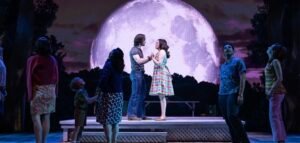
Pamela Gray, who wrote the original screenplay, has created an emotionally perceptive theatrical adaptation. The book understands that personal transformations rarely occur cleanly. Pearl’s awakening happens alongside that of her teenage daughter, Alison, who discovers first love with the wonderfully awkward and exuberant Ross. Mother and daughter are crossing different thresholds at the same moment, each becoming more aware of herself and the world around her.
Talia Suskauer gives Pearl longing, vulnerability and a convincing hunger for something beyond domestic routine. Sam Gravitte makes Walker effortlessly charming, while Max Chernin brings tremendous sympathy to Marty. His tender musical moment with his daughter, “We Made You,” is among the production’s most affecting scenes.
Sophie Pollono is excellent as Alison, capturing the certainty, idealism and emotional volatility of adolescence. Oscar Williams nearly steals the evening as Ross. His energy, comic instincts and natural charisma brighten every scene he enters. Andréa Burns is equally persuasive as Lillian, Pearl’s wise and witty mother-in-law, grounding the family with humor and hard-earned understanding.

AnnMarie Milazzo’s score, with additional lyrics by Gray, is melodic and often moving, even if it does not always capture the musical danger and psychedelic electricity associated with 1969. The songs work best during the intimate family moments, when characters express feelings they cannot communicate through dialogue alone. Sheryl Kaller’s direction and Tal Yarden’s visual design effectively place the domestic story against the moon landing, Woodstock and a country undergoing enormous change.
A Walk on the Moon is ultimately not an endorsement of Pearl’s affair. It is a compassionate examination of a woman realizing that she has become a supporting character in her own life. The musical asks whether awakening must destroy what came before—or whether love, marriage and identity can evolve.

Like the moon landing itself, Pearl’s journey represents a step into unfamiliar territory. The result is a thoughtful, beautifully performed musical about desire, responsibility and the frightening courage required to imagine a different life.